LeafTreeGen
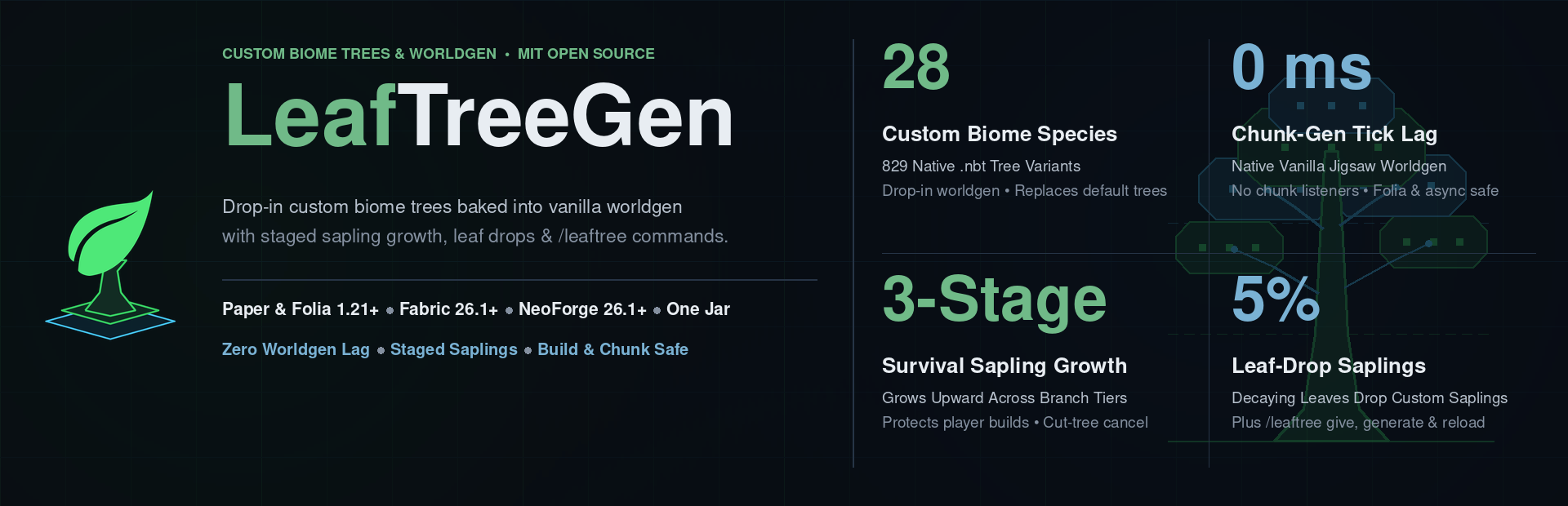
Procedural custom tree generator, native .nbt worldgen datapack baker, and staged sapling-growth plugin and mod (LeafTreeGen-<version>.jar) for Paper, Folia, Fabric, and NeoForge.
Overview
LeafTreeGen generates 28 bundled tree species (154 procedural tiers and 829 .nbt structure variants) in pure Java and places them natively via Minecraft's jigsaw worldgen. On startup (during the pre-world bootstrap phase on Paper and Folia via PaperBootstrap), the plugin bakes each procedural species into palette-compressed vanilla structure templates (.nbt) and wires them into worldgen/template_pool, worldgen/structure, worldgen/structure_set, and optional replace-vanilla placed_feature overrides. Players and builders can also plant tagged custom saplings (/leaftree give), watch trees reveal upward across branch tiers (GrowthManager), harvest species saplings from decaying leaves (sapling-drop-chance), or place individual trees at their cursor (/leaftree generate).
Architecture & Common-API Integration
LeafTreeGen ships as a single shaded multi-loader jar (:resource:LeafTreeGen:treegen-plugin) built on the shared DailyStruggle/RTP common API:
treegen-common: Platform-agnostic core (LeafTreeGenRuntime,TreeGenEventController,ProceduralGenerator,DatapackGenerator,GrowthManager,GrowthPlanner,SegmentedTreeModel,TreeBlockBatcher,TreeFarmStore,SaplingDropResolver,LeafTreeGenCommand) powered by::server-api(ServerAccessor,WorldEventHook,TaggedItemSpec,BlockPos3i,CallerLocation):commands-api(CommandsAPI,CommandsAPICommand,CommandParameter):yaml-api(RtpYamlConfig):predict-api(UnitCurve,PolarCurve,PerlinNoise,DistributionSampler,BudgetPacer,EwmaEstimator):anvil-api(io.github.dailystruggle.anvil.Nbtfor.nbtstructure verification)treegen-paper: Paper and Folia carrier (PaperBootstrap+PaperLeafTreeGenPlugin) backed by:bukkit:bukkit-common(BukkitPluginServerAccessor).treegen-fabric: Fabric (26.1.x) carrier (FabricMod) backed by:fabric:fabric-common-unobf(FabricModServerAccessor).treegen-neoforge: NeoForge (26.1.x) carrier (NeoForgeMod) backed by:neoforge:neoforge-v26_1_R1(NeoForgeModServerAccessor).
Design Highlights
- Pre-World Bootstrap Jigsaw Worldgen (
DatapackGenerator&PaperBootstrap): Writes a complete vanilla worldgen datapack before worlds load (with a SHA-256.treegen-fingerprintcache so warm restarts skip rebaking), letting Minecraft's native jigsaw and structure worker threads handle placement with zero runtime chunk-populate listeners. - Staged Sapling Growth (
GrowthPlanner&GrowthManager): Reveals planted saplings additively across foliated branch tiers (growth.enabled,growth.totalTime) after a pooled pre-flight footprint check, cancels cleanly if trunk wood is broken, and persists active growth per chunk across restarts. - Per-Chunk Slicing & Adaptive Tick Pacing (
SegmentedTreeModel&TreeBlockBatcher): Slices trees by[0..15, 0..15]chunk in wood-first (logs, stems, hyphae), leaf-distance-ascending order, paces runtime block batches viaBudgetPacer+EwmaEstimator(time-allocation-ms: 5.0), and queues unloaded neighbor chunk overhangs untilonChunkLoad(0synchronous unloaded-chunk loads). - Hybrid Sapling-Drop Farming (
TreeFarmStore&SaplingDropResolver): Breaking or decaying custom tree leaves drops the matching species' tagged sapling (sapling-drop-chance: 0.05), resolving from per-chunkTreeFarmStoreregions first and biome + primary/secondary/underside leaf blocks second.
Requirements
- Java 21+ (Java 25 on Minecraft
26.x;treegen-commoncompiles to Java 17 bytecode). - One of: Paper or Folia
1.21+, Fabric26.1+, or NeoForge26.1+. - Zero external plugin dependencies (
commands-api,server-api,yaml-api, andpredict-apiare shaded and minimized insideLeafTreeGen-<version>.jar).
Configuration
The plugin's behavior is configured via config.yml, while tree species are defined in individual JSON files within the species/ directory.
For the demo world, see docs/biome-trees.md for the table mapping each vanilla biome to its iconic tree species.
Species Definitions (species/*.json)
Species are loaded from JSON files. The plugin supports both single-object definitions and arrays (used by procedural configs).
Example species/my_tree.json:
{
  "name": "jacaranda-grove",
  "trunk": "minecraft:oak_log",
  "leaves": "minecraft:azalea_leaves",
  "heightMin": 5,
  "heightMax": 10,
  "biomes": [ "minecraft:plains" ]
}
Placement Overrides (config.yml)
Use config.yml to map species to biomes and tune worldgen placement without modifying the base species files.
generation-mode: DATAPACK

datapack:
  name: leaf-treegen-generated
  description: "LeafTreeGen generated worldgen."

placement:
  my_tree:
    spacing: 5
    separation: 2
    biomes: ["minecraft:forest"] # Override species biomes
Adding a New Tree (Step-by-Step)
To add a new tree species to the server:
- Define the Species: Create a species JSON in
plugins/leaf-treegen/species/my_tree.json(procedural parameters, includingcountfor the number of baked variants). - Map Placement (Optional): Add biome/placement overrides under
placement:inconfig.yml. - Reload: Run
/leaftree reloadin-game. InDATAPACKmode the plugin bakes the.nbtvariants and regenerates the worldgen datapack automatically.
Pre-baked .nbt templates may still be dropped into datapacks/.../data/<namespace>/structure/<group>/ and referenced via variants; tools/tree-gen can produce these as a reference.
Configuration Details
display-name: Name used in commands and item tooltips.namespace: The namespace for the generated structures (default:minecraft).group: Subfolder understructure/where.nbtfiles are located (default: species ID).biomes: List of biome IDs where the tree can spawn or be planted.sapling-item: The vanilla sapling base used for custom saplings (default:OAK_SAPLING).worldgen: Boolean to enable/disable natural placement (default: true if biomes are present).generation-mode: How trees are placed (see below).spacing/separation/salt: Standard vanilla structure placement parameters for the generated datapack.variants: (Optional) Explicit list of variants. If omitted, the plugin scans the world's datapacks for any.nbtfiles in the specifiednamespace:groupfolder.location: Full resource location of the.nbt(e.g.,leaf:dark_forest/my_tree).weight: Relative probability of this variant being chosen.procedural: (Optional) block to enable algorithmic generation.trunk-block/leaf-block: Voxel types.height-min/height-max: Height range.trunk-width: Base radius.trunk-shape:CONSTANT,LINEAR,PARABOLIC.lean-angle/lean-azimuth: Tilt controls.canopy: Define leaf layers withyOffsetandradius.
Usage
For Players
Players can plant special NBT-tagged saplings. These saplings will grow into a random custom variant of the configured species if planted in a valid biome.
For Admins
Use the /leaftree command (requires leaftreegen.admin permission; uses commands-api name=value parameters):
/leaftree generate species=<id> [world=<name>] [x=<~|n>] [y=<~|n>] [z=<~|n>]: Place a random variant at your cursor or target coordinates./leaftree give species=<id> [player=<name>] [amount=<1..64>] [variant=<key>]: Distribute tagged saplings (random or pinned to a variant)./leaftree list [species=<id>]: List all registered species or inspect available variants for one species./leaftree reload: Reloadconfig.ymlandspecies/*.jsonand regenerate worldgen datapacks if changed./leaftree debug: Dump active generation mode, loaded worlds, and per-species biome/worldgen status./leaftree stats [reset=<true|false>]: Inspect or resetTreeBlockBatchertick-budget telemetry.
Generation Modes
LeafTreeGen can place trees using two different methods, switchable in config.yml via generation-mode:
- DATAPACK: Pure-datapack, native jigsaw-based generation via an auto-generated datapack (425 active / 829 total .nbt variants across 26 structure_sets). Recommended default on Paper & Folia (Moonrise parallel worldgen).
- PROCEDURAL: Runtime placement during chunk load via [0..15, 0..15] chunk slicing and TreeBlockBatcher (<= 5.0 ms/tick). Ties DATAPACK generation speed on Paper/Folia (with 13-15 s faster cold server boot) and runs 1.7x to 3.5x faster than DATAPACK on Fabric & NeoForge by avoiding vanilla ServerChunkCache structure-reference neighbor cascades.
- BOTH: Use both methods.
- NONE: Disable automatic placement (and remove any previously generated datapacks/leaf-treegen-generated/ folder on startup).
24-Cell Clean-Boot Benchmark Matrix: NONE vs DATAPACK vs PROCEDURAL & .mca vs .lca (seed=8675309)
Measured across 4 platforms (Paper 26.2, Folia 26.2, NeoForge 26.1.2, Fabric 26.1.2), 2 storage formats (vanilla .mca vs .lca LeafCraft Anvil via LeafAnvil Mode A 0-LZ), and 3 tree modes (NONE vanilla baseline, DATAPACK, PROCEDURAL) on verified high-density dry-land forest and birch_forest coordinates (surfaceY = 73..82, >2,400 tree voxels/chunk):
- Stage 1 - Pure 64-Chunk Forest Generation (
r.-1.0,(-256, 256)..(-129, 383)): Single rectangular/forceload add -256 256 -129 383(0RCON loop overhead), placing169,165 to 172,797custom tree blocks inPROCEDURALmode. Tracks end-to-endWalltime, server-sideChunk Win(first-to-lastChunkLoadEvent),Total Win(firstChunkLoadEventto lastTreeBlockBatcherplacement), andBatcherCPU/block telemetry. - Stage 2 - Rolling 4-Wave Load/Unload + Frontier Generation (
128new chunks across4regions): 4 sequential 32-chunk waves acrossr.0.0,r.-1.-1,r.-2.0, andr.3.2(218,748 to 218,835custom tree blocks placed inPROCEDURAL). Each wave unloads the prior wave's ticket and runssave-allwhile generating 32 new forested chunks, stressing concurrent region serialization and chunk generation. - Stage 3 - 192-Chunk Load/Unload Queue Churn: Sequentially reloads and unloads all
192generated chunks (Stage 1 + Stage 2) throughRegionFileStorage(.mcavs.lca).
A. Paper 26.2 & Folia 26.2 (Moonrise Async Chunk System)
| Platform | Storage | Mode | Boot (s) |
P1: 64-Chunk Gen Wall (ch/s) |
P1: Server Chunk Win / Total Win (ms) |
P1: Batcher (ms / blocks) |
P2: 128-Chunk Rolling Gen+Save Wall (ch/s) |
P2: Batcher (ms / blocks) |
P3: 192-Chunk Load/Unload Wall (ch/s) |
Region Disk Size (MB) |
|---|---|---|---|---|---|---|---|---|---|---|
Paper 26.2 |
MCA |
NONE |
16.31 |
5.02 s (12.75) |
3,337 / 3,337 |
0.0 / 0 |
10.30 s (12.43) |
0.0 / 0 |
1.18 s (163.3) |
28.89 MB (32 .mca) |
Paper 26.2 |
LCA |
NONE |
18.35 |
4.79 s (13.36) |
3,021 / 3,021 |
0.0 / 0 |
12.81 s (9.99) |
0.0 / 0 |
2.03 s (94.7) |
7.53 MB (32 .lca, -73.9%) |
Paper 26.2 |
MCA |
DATAPACK |
29.30 |
7.75 s (8.26) |
4,551 / 4,551 |
0.0 / 0 |
19.70 s (6.50) |
0.0 / 0 |
1.14 s (169.2) |
29.10 MB (32 .mca) |
Paper 26.2 |
LCA |
DATAPACK |
30.81 |
7.41 s (8.64) |
4,362 / 4,362 |
0.0 / 0 |
19.55 s (6.55) |
0.0 / 0 |
1.26 s (153.0) |
8.04 MB (32 .lca, -72.4%) |
Paper 26.2 |
MCA |
PROCEDURAL |
15.62 |
7.78 s (8.23) |
2,770 / 5,527 |
390.3 ms / 172,797 |
19.64 s (6.52) |
154.7 ms / 218,748 |
0.98 s (194.9) |
28.78 MB (32 .mca) |
Paper 26.2 |
LCA |
PROCEDURAL |
16.04 |
7.44 s (8.60) |
2,623 / 5,374 |
338.7 ms / 172,797 |
20.01 s (6.40) |
310.6 ms / 218,748 |
1.22 s (157.8) |
7.54 MB (32 .lca, -73.8%) |
Folia 26.2 |
MCA |
NONE |
15.36 |
4.83 s (13.26) |
1,140 / 1,140 |
0.0 / 0 |
11.10 s (11.53) |
0.0 / 0 |
3.80 s (50.5) |
28.85 MB (32 .mca) |
Folia 26.2 |
LCA |
NONE |
16.77 |
4.90 s (13.07) |
1,133 / 1,133 |
0.0 / 0 |
12.82 s (9.98) |
0.0 / 0 |
3.25 s (59.0) |
7.42 MB (32 .lca, -74.3%) |
Folia 26.2 |
MCA |
DATAPACK |
28.72 |
8.11 s (7.89) |
1,777 / 1,777 |
0.0 / 0 |
22.47 s (5.70) |
0.0 / 0 |
3.75 s (51.2) |
28.98 MB (32 .mca) |
Folia 26.2 |
LCA |
DATAPACK |
29.57 |
8.27 s (7.74) |
1,900 / 1,900 |
0.0 / 0 |
23.97 s (5.34) |
0.0 / 0 |
3.87 s (49.6) |
7.86 MB (32 .lca, -72.9%) |
Folia 26.2 |
MCA |
PROCEDURAL |
13.93 |
8.02 s (7.98) |
1,389 / 4,442 |
449.2 ms / 172,785 |
22.40 s (5.71) |
162.5 ms / 218,750 |
3.70 s (51.9) |
28.64 MB (32 .mca) |
Folia 26.2 |
LCA |
PROCEDURAL |
15.05 |
7.72 s (8.29) |
1,132 / 4,343 |
516.2 ms / 172,795 |
23.66 s (5.41) |
215.8 ms / 218,768 |
4.07 s (47.2) |
7.38 MB (32 .lca, -74.2%) |
B. Fabric 26.1.2 & NeoForge 26.1.2 (Vanilla ServerChunkCache / ChunkMap)
| Platform | Storage | Mode | Boot (s) |
P1: 64-Chunk Gen Wall (ch/s) |
P1: Server Chunk Win / Total Win (ms) |
P1: Batcher (ms / blocks) |
P2: 128-Chunk Rolling Gen+Save Wall (ch/s) |
P2: Batcher (ms / blocks) |
P3: 192-Chunk Load/Unload Wall (ch/s) |
Region Disk Size (MB) |
|---|---|---|---|---|---|---|---|---|---|---|
NeoForge 26.1.2 |
MCA |
NONE |
13.57 |
8.95 s (7.15) |
6,807 / 6,807 |
0.0 / 0 |
18.33 s (6.98) |
0.0 / 0 |
1.44 s (133.2) |
24.85 MB (34 .mca) |
NeoForge 26.1.2 |
LCA |
NONE |
14.84 |
10.09 s (6.34) |
7,570 / 7,570 |
0.0 / 0 |
21.42 s (5.98) |
0.0 / 0 |
1.46 s (131.3) |
8.76 MB (24 .lca, -64.8%) |
NeoForge 26.1.2 |
MCA |
DATAPACK |
28.31 |
26.29 s (2.43) |
12,917 / 12,917 |
0.0 / 0 |
87.04 s (1.47) |
0.0 / 0 |
1.39 s (138.6) |
25.02 MB (34 .mca) |
NeoForge 26.1.2 |
LCA |
DATAPACK |
33.94 |
36.75 s (1.74) |
18,013 / 18,013 |
0.0 / 0 |
95.12 s (1.35) |
0.0 / 0 |
2.11 s (91.2) |
8.87 MB (24 .lca, -64.6%) |
NeoForge 26.1.2 |
MCA |
PROCEDURAL |
11.81 |
15.76 s (4.06) |
6,747 / 12,728 |
280.8 ms / 169,171 |
30.58 s (4.19) |
714.7 ms / 218,828 |
1.36 s (141.2) |
24.48 MB (34 .mca) |
NeoForge 26.1.2 |
LCA |
PROCEDURAL |
12.60 |
15.97 s (4.01) |
6,724 / 12,757 |
330.9 ms / 169,173 |
33.22 s (3.85) |
452.3 ms / 218,835 |
1.20 s (160.0) |
8.86 MB (24 .lca, -63.8%) |
Fabric 26.1.2 |
MCA |
NONE |
14.34 |
9.57 s (6.69) |
7,514 / 7,514 |
0.0 / 0 |
17.68 s (7.24) |
0.0 / 0 |
1.43 s (134.6) |
24.79 MB (34 .mca) |
Fabric 26.1.2 |
LCA |
NONE |
15.83 |
10.73 s (5.97) |
7,769 / 7,769 |
0.0 / 0 |
21.37 s (5.99) |
0.0 / 0 |
1.46 s (131.4) |
8.73 MB (24 .lca, -64.8%) |
Fabric 26.1.2 |
MCA |
DATAPACK |
34.09 |
34.63 s (1.85) |
17,055 / 17,055 |
0.0 / 0 |
109.58 s (1.17) |
0.0 / 0 |
1.40 s (137.1) |
24.96 MB (34 .mca) |
Fabric 26.1.2 |
LCA |
DATAPACK |
35.12 |
35.93 s (1.78) |
16,393 / 16,393 |
0.0 / 0 |
94.73 s (1.35) |
0.0 / 0 |
2.20 s (87.3) |
8.84 MB (24 .lca, -64.6%) |
Fabric 26.1.2 |
MCA |
PROCEDURAL |
12.79 |
15.63 s (4.09) |
6,346 / 12,482 |
274.9 ms / 169,165 |
31.47 s (4.07) |
516.5 ms / 218,830 |
1.62 s (118.5) |
24.46 MB (34 .mca) |
Fabric 26.1.2 |
LCA |
PROCEDURAL |
13.54 |
15.50 s (4.13) |
6,062 / 12,252 |
374.0 ms / 169,176 |
31.70 s (4.04) |
762.3 ms / 218,835 |
1.29 s (148.8) |
8.85 MB (24 .lca, -63.8%) |
C. Architectural Takeaways (NONE vs DATAPACK vs PROCEDURAL & .mca vs .lca)
- Neither Tree Path Is Free vs Vanilla (
NONE), and Platform Scheduler Determines the Winner: - Cold Boot Overhead (
DATAPACKvsNONE/PROCEDURAL):DATAPACKadds+13 s to +20 sto cold server startup (28.3-35.1 svs11.8-18.4 s) while Minecraft'sDataFixerUpperand registry loader parse, validate, and index425.nbtstructure templates and26structure_sets. - Paper & Folia (
Moonrise):DATAPACKandPROCEDURALfinish in a virtual tie (7.41-8.27 svs7.44-8.02 sin Stage 1;19.55-23.97 svs19.64-23.66 sin Stage 2).DATAPACKuses0 msof plugin batcher time but widens Moonrise'sSTRUCTURE_STARTS/FEATURESworker window (4,362-4,551 msvs3,021-3,337 msinNONEon Paper).PROCEDURALkeeps the worker chunk-generation window at vanilla speed (2,623-2,770 mson Paper,1,132-1,389 mson Folia), waits2.0 s(40ticks) for neighbor chunks, and spreads172,797block placements acrossTreeBlockBatcher(338.7-516.2 mstotal across429batches,0.79-1.20 ms/batch). - Fabric & NeoForge (Vanilla
ServerChunkCache):PROCEDURALis1.7x-2.3xfaster thanDATAPACKin Stage 1 (15.50-15.97 svs26.29-36.75 s) and2.8x-3.5xfaster in Stage 2 (30.58-33.22 svs87.04-109.58 s), avoiding vanillaServerChunkCache's 8-chunk structure-reference neighbor cascades when26customstructure_sets are active during rolling unloads. - Open
.lcaFormat (anvil-api, MIT) +LeafAnvilRuntime Storage: - Disk Reduction (
-63.8% to -74.3%): Every.lcarun intercepted all18RegionFileStorageinstances (0.mcafiles written), shrinking generated forest regions from28.64-29.10 MBto7.38-8.04 MB(3.6x-3.9xsmaller) on Paper/Folia and from24.46-25.02 MBto8.73-8.87 MB(2.8xsmaller) on Fabric/NeoForge. - Generation & Queue Churn Throughput: During CPU-bound tree generation (Stages 1 & 2),
.lcamatches.mcawithin1%-6%(slightly faster across all 3 Paper Stage 1 modes and+13.6%faster on FabricDATAPACKStage 2). In Stage 3 (192-chunk reload/unload churn),.lcaoutperforms.mcaby+12% to +20%on Fabric and NeoForgePROCEDURAL(160.0 ch/svs141.2 ch/son NeoForge;148.8 ch/svs118.5 ch/son Fabric), while on Paper's page-cached queue.mca(0.98-1.18 s) is~0.12-0.24 s(~0.6-1.2 ms/chunk) faster than.lca(1.22-1.26 s). - Open Codec & Zero Lock-In: The
.lcabinary specification (ICD.md) andanvil-apiJava codec (AnvilRegionInspectorCli,LcaRegionReader,LcaRegionWriter) are free and MIT-licensed, so.lcaworlds can be inspected, pre-filtered byLeafRTP, or converted back to.mcaoffline withoutLeafAnvil.jar.
Building & Testing
# Build the unified multi-loader LeafTreeGen-<version>.jar (Paper, Folia, Fabric, NeoForge)
./gradlew :resource:LeafTreeGen:treegen-plugin:build

# Run all 83 unit, datapack, and stateful fuzz tests
./gradlew :resource:LeafTreeGen:check
The resulting multi-loader jar is written to resource/LeafTreeGen/treegen-plugin/build/libs/LeafTreeGen-<version>.jar.